
Wherever you go, there's always one of them- in this case, two. On one hand you have the man shouting to the crowds that The End Is Nigh, brought upon man by his own folly; on the other hand you have that old looney who draws flying machines on every spare scrap of paper. Hawthorne and Bush don't go quite that far towards the end of the spectrum, but these are the two extremes towards which they gravitate.
Vannevar Bush has a very positive view towards technology, but knowing that he also refers to martial advances like nuclear weapons, I have some difficulties looking at his views without bias. He has little to say about the duality of technological advances, but instead focuses fiercely on the positive while ignoring any negatives that might result. It seems probable that this is a mindset required in scientists to a certain degree, or no scientific advances would ever be made. However, I will forego further discourse on the topic and focus more closely on one specific aspect of Bush's view for the future- the Memex. He is clearly envisioning, through the lens of the technology available at that time, a computer and scanner, although the implementation is a little different than that of the usual college student. The most unique feature of the Memex, and the one closest in implementation to the internet, is the linking of one piece of material to another. Indeed, this is one of the main functions of the internet insofar as I am concerned. For example- I am looking for a halloween costume, and I spent my afternoon looking into the possibilities provided by the original Star Wars trilogy. Having decided that I did not want to go the route of wearing Leia's iconic white dress, I began searching the internet for Star Wars costuming sites. I traveled from one costuming resource to another via links on each website, with occasional forays into online shops suggested in do-it-yourself articles. These websites were all about a common interest, but the people involved in them were scattered across the country and the globe. The only reason so many widely disparate resources were available to me was that they were linked together in chains, webs, and occasionally knots. I could even bookmark the whole grouping of sites, placing them in a separate folder for yet more perusal at a later date. This is almost exactly the sort of thing Bush describes people doing on the Memex
Hawthorne's fears- the loss of community, of connection with the outside world, of beauty- are the fears that greet every change and technological advance. Being a writer, and of a prolific turn of mind, he addresses his fears in a deeper and more dramatic way than most people might, but this does not discount the validity of his argument. We know even now the difference between sitting in front of a fire and hearing the gentle roar of air through ducts. I have never gathered with friends or family in front of a furnace for an evening of conviviality. Hawthorne's argument that "there will be nothing to attract these poor children to one centre", however, is flawed. Humans are social creatures, and the social center of the household has simply moved. Where it has moved may depend on the family or the group, but I suspect many people hold fond memories of meals where food was secondary to the conversation and companionship. "The easy gossip--the merry, yet unambitious jest--the life-long, practical discussion of real matters in a casual way" (Hawthorne) has not disappeared from the earth at all. The setting has merely changed. One setting which would surely have shocked Hawthorne is the internet. From the advances in technology which he so feared heralded an end to human interaction has come a new tool which allows you to speak, quickly and conveniently, with people both far and near. At this very moment, it is allowing me to communicate with my professor, albeit in a formal and very specific way- i.e. posting this essay to my blog. More importantly to me, there are now four or five ways to arrange dinner or coffee together- or an evening talking in front of a roaring fire. Of course, every technology does have its downside, and the internet is no exception. It also allows people to isolate themselves, to commit crimes with greater ease, to stop viewing face-to-face communication as necessary and valuable. It is right for Hawthorne, and for us, to view changes with a certain amount of trepidation. We should only be careful not to carry it too far.
Bush, Vannevar. “As We May Think.” The Atlantic Monthly. July 1945. Ver. by Denys Duchier. University of Ottawa. April 1994. http://www.ps.uni-sb.de/~duchier/pub/vbush/vbush-all.shtml
Hawthorne, Nathaniel. “Fire-Worship.” Mosses from an Old Manse. 1846. http://www.eldritchpress.org/nh/fw.html
Sunday, September 17, 2006


Tuesday, September 5, 2006
In Which I Write An Extremely Unreliable History
My memory is notoriously poor for things in the real world. So, I cannot tell you exactly what kind of computer I first used. I know it was an Apple Macintosh, probably a PowerMac. What I remember best about it, however, is the black and white monitor. I whiled away many a happy hour of my very early childhood toying with a program called KidPix, making large, multi-shaded blobs of grey. The thing about KidPix, of course, is that all those effects that just made shades of grey on our monitor were meant to be eye-smarting rainbows. So the day my father brought a color monitor home from the office (he worked as a systems administrator at Duke) was quite a revelation. For a long time KidPix, Glider (a game involving a paper airplane), and Ingmar (a skiing game) were my primary amusements on the computer. There were probably a couple of others- I seem to recall something having to do with air hockey- but a computer was basically a toy.
At some point, we acquired a new computer, this time a beige PowerMac.

It came with a new monitor, which probably why I remember at all. It was on this machine that I was to write such literary greats as "Quartz" and "The Capybara". Suddenly it wasn't just a toy- it was a toy I could pretend to do my homework on! We acquired a few more games to keep me from accruing hideous library fines- Where In Time Is Carmen Sandiego, and Starship Titanic. At this point, I was aware of the internet, although we didn't yet have access at home. My father had introduced me to it on one of many visits to his office in a desperate effort to keep me quiet and occupied. At the time it all seemed rather silly and complicated to me- all it seemed to do was let you talk to strangers, which I wasn't too keen on, or look at pictures of people's children and pets, which I could do just by wandering around the building. I went back to checking out as many books as the library would let me.
In desperation my parents moved out into the county. In fact, this probably had something to do with the number of car crashes that occurred at the intersection in front of our house, but that's neither here nor there. The really important part is that, at the age of 9 or 10, my father purchased a modem and a dialup internet connection.
Looking back, it was painfully slow, and I spent hardly any time online at first. I learned about email, and after a brief struggle with the idea of not having to buy stamps or in any way pay postage, thought it very interesting in a nonfunctional sort of way. After all, who could I email but my parents? My father introduced me to a web directory for kids called Yahooligans, which I decided was actually useful, because it allowed my to access things of actual interest on the web- games, the websites of my favorite authors, and an academic reference at my fingertips. That all went very well and smoothly for a while, and I was beginning to see that the internet might not be as silly as I initially thought. I even met a few people I could email back and forth with.
Then came a new computer- an iMac G4.

This was a big step up. I was astonished by the speed and the size of the hard drive, and by the idea of having my own private workspace. And finally, finally, I was allowed to install AIM. It was a revolution in my computer usage. My parents never got the chance to complain about my being on the phone all the time. They had to go straight to prying my away from the keyboard with a crowbar. A year or so later, I gave in and got a Livejournal, which I began abusing egregiously. It was somewhere in this period of time where my computer usage shifted its emphasis from amusement to communication.
These days, I've finally diversified. I still play games- in fact, I'm a point-and-click junkie, and turn to Lazylaces for my daily fix. My Livejournal friends page is my homepage, and Fire (my AIM client) is always running, even though I haven't taken down my away message in ages. But I also use the 'net to find recipes, quotes, and lyrics. I windowshop and do leisure research on my various pet topics. I keep huge catalogs of photos that I and my friends have taken, and download music, books, and the occasional movie or television show. I even use it for schoolwork sometimes. All of this I do on a 1 year old iMac G5, which will never be as cute as the G4.
At some point, we acquired a new computer, this time a beige PowerMac.
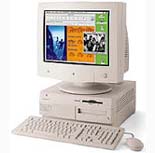
It came with a new monitor, which probably why I remember at all. It was on this machine that I was to write such literary greats as "Quartz" and "The Capybara". Suddenly it wasn't just a toy- it was a toy I could pretend to do my homework on! We acquired a few more games to keep me from accruing hideous library fines- Where In Time Is Carmen Sandiego, and Starship Titanic. At this point, I was aware of the internet, although we didn't yet have access at home. My father had introduced me to it on one of many visits to his office in a desperate effort to keep me quiet and occupied. At the time it all seemed rather silly and complicated to me- all it seemed to do was let you talk to strangers, which I wasn't too keen on, or look at pictures of people's children and pets, which I could do just by wandering around the building. I went back to checking out as many books as the library would let me.
In desperation my parents moved out into the county. In fact, this probably had something to do with the number of car crashes that occurred at the intersection in front of our house, but that's neither here nor there. The really important part is that, at the age of 9 or 10, my father purchased a modem and a dialup internet connection.
Looking back, it was painfully slow, and I spent hardly any time online at first. I learned about email, and after a brief struggle with the idea of not having to buy stamps or in any way pay postage, thought it very interesting in a nonfunctional sort of way. After all, who could I email but my parents? My father introduced me to a web directory for kids called Yahooligans, which I decided was actually useful, because it allowed my to access things of actual interest on the web- games, the websites of my favorite authors, and an academic reference at my fingertips. That all went very well and smoothly for a while, and I was beginning to see that the internet might not be as silly as I initially thought. I even met a few people I could email back and forth with.
Then came a new computer- an iMac G4.

This was a big step up. I was astonished by the speed and the size of the hard drive, and by the idea of having my own private workspace. And finally, finally, I was allowed to install AIM. It was a revolution in my computer usage. My parents never got the chance to complain about my being on the phone all the time. They had to go straight to prying my away from the keyboard with a crowbar. A year or so later, I gave in and got a Livejournal, which I began abusing egregiously. It was somewhere in this period of time where my computer usage shifted its emphasis from amusement to communication.
These days, I've finally diversified. I still play games- in fact, I'm a point-and-click junkie, and turn to Lazylaces for my daily fix. My Livejournal friends page is my homepage, and Fire (my AIM client) is always running, even though I haven't taken down my away message in ages. But I also use the 'net to find recipes, quotes, and lyrics. I windowshop and do leisure research on my various pet topics. I keep huge catalogs of photos that I and my friends have taken, and download music, books, and the occasional movie or television show. I even use it for schoolwork sometimes. All of this I do on a 1 year old iMac G5, which will never be as cute as the G4.
In Which Too Much Poetry Rots Your Brain
or
A Test Post
or
A Test Post
Tiger, tiger, burning bright
In the forests of the night,
What immortal hand or eye
Dare frame thy fearful symmetry?
In the forests of the night,
What immortal hand or eye
Dare frame thy fearful symmetry?
Subscribe to:
Comments (Atom)